

The study aimed to assess adherence to immunosuppressive medications among kidney transplant patients (KTPs) and to compare adherence rates for tacrolimus, cyclosporine, and sirolimus. Out of 63 patients treated at the Clinic of Nephrology, Clinical Centre Niš, Serbia, 60 participated in the study. Medication adherence was evaluated using the Simplified Medication Adherence Questionnaire (SMAQ), and patients were classified as adherent (43) or nonadherent (17). Statistical analysis was performed using the Student’s t-test.
Results showed that 71.7% of patients were adherent to their prescribed therapy, while 28.3% were nonadherent. Nonadherent patients had significantly lower estimated glomerular filtration rate (eGFR) compared to adherent patients, indicating poorer graft function. Additionally, tacrolimus levels were significantly lower in the nonadherent group. The findings highlight that although adherence levels were generally high, nonadherence remains associated with worse transplant outcomes, emphasizing the need for early identification and interventions to improve medication adherence.
This cross-sectional study was conducted at the Clinic of Nephrology, Clinical Centre Niš, Serbia. A total of 63 kidney transplant patients attending follow-up visits between January and April 2013 were included. Participants were ≥18 years old, had undergone kidney transplantation at least one year earlier, were on continuous immunosuppressive therapy (Tacrolimus, Cyclosporine A, or Sirolimus) for at least one year, and had only one renal transplant. The main causes of end-stage kidney disease were chronic glomerulonephritis, chronic pyelonephritis and diabetic nephropathy. All patients received immunosuppressants along with mycophenolate mofetil and prednisone. Ethical approval was obtained, and informed consent was collected from all participants.
Medication adherence was assessed through face-to-face interviews using a structured questionnaire and the Simplified Medication Adherence Questionnaire (SMAQ). The six-item SMAQ evaluated forgetfulness, treatment routine, adverse effects, and missed doses. Patients were classified as adherent if they followed all adherence criteria and missed no more than two doses in the last week or two days in the previous three months; otherwise, they were classified as nonadherent.
Additional clinical data—including donor type, immunosuppressant regimen, number of medications, time since transplant, primary kidney disease, weight, blood pressure, and drug levels—were collected from medical records. Estimated glomerular filtration rate (eGFR) was calculated using the MDRD formula, and blood samples were taken on the same day as the questionnaire.
Data were analyzed using SPSS version 19.0. The Student’s t-test was used to compare variables between groups, and p < 0.05 was considered statistically significant. Results were expressed as mean ± standard deviation.
Out of 63 patients approached, 60 kidney transplant recipients participated in the study (response rate 96.8%). The mean age was 44.45 ± 11.37 years, with 63.3% males and 36.7% females. Most patients (76.7%) received grafts from living donors, and the average time since transplantation was 5.34 ± 3.84 years. Tacrolimus was the most commonly prescribed immunosuppressant (75%), followed by cyclosporine (18.3%) and sirolimus (6.7%). According to the SMAQ, 71.7% of patients were adherent to their medication regimen.
Nonadherence was slightly higher among patients receiving cyclosporine (36.4%) compared to tacrolimus (26.7%) and sirolimus (25%), though the difference was not statistically significant. Nonadherent patients had significantly poorer graft function, with lower eGFR than adherent patients. Tacrolimus levels were also significantly lower in nonadherent patients, although still within therapeutic ranges. The main reason for nonadherence was forgetfulness (88.2%), while intentional discontinuation due to feeling worse accounted for 11.8% of cases.
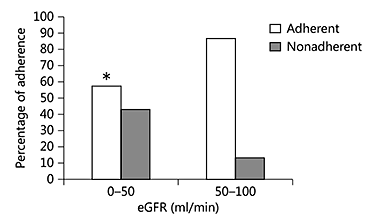
Adherence to immunosuppressive therapy among kidney transplant patients was high (71.7%) based on the SMAQ assessment. A significant association was observed between medication adherence and tacrolimus levels as well as graft function (eGFR), with nonadherent patients showing lower tacrolimus levels and poorer graft function. However, no significant relationship was found between adherence and factors such as age, gender, time since transplant, donor type, blood pressure, or number of medications. The most common cause of nonadherence was forgetfulness, while intentional discontinuation of medication was rare.
Overall, only 28.3% of patients were nonadherent, which is comparable to findings from other studies. Good adherence may be influenced by patients’ awareness of the risk of graft loss and return to dialysis. The study highlights the importance of patient education, counseling, simplified medication regimens, and reminder strategies (such as alarms or pillboxes) to improve adherence. Despite limitations such as small sample size and cross-sectional design, the findings emphasize that consistent use of immunosuppressive medications is crucial for maintaining graft function and long-term transplant survival.
1. Theofilou P: Identifying risk factors associated with compliance to medication in elderly kidney transplant patients. J Transplant Technol Res 2012;2:2-3.
2. McKay DB, Steinberg SM: Kidney Transplantation: A Guide to the Care of Kidney Transplant Recipients. New York, Springer, 2010, pp 371-372.
3. De Geest S, Abraham I, Dunbar-Jacob J, et al: Behavioral strategies for long-term survival of transplant recipients; in Metry J, Meyer U (eds): Drug Regimen Compliance: Issues in Clinical Trials and Patient Management. Chichester, John Wiley & Sons, 1999, pp 163-180.
4. Constantiner M, Cukor D: Barriers to immunosuppressive medication adherence in high-risk adult renal transplant recipients. Dial Transplant 2011;40:60-66.
5. Schmid-Mohler G, Pechula Thut M, Wüthrich RP, et al: Non-adherence to immunosuppressive medication in renal transplant recipients within the scope of the integrative model of behavioral prediction: a cross-sectional study. Clin Transplant 2010;24:213-222.
6. Gaston R, Hudson S, War M, et al: Late renal allograft loss: noncompliance masquerading as chronic rejection. Transplant Proc 1999;31:21S-23S.
7. Papajcik D, Mastroianni B, Goormastic M, et al: A tool to identify risk factors for noncompliance in the adult renal transplant recipient. Transplant Proc 1999;31:84-86.
8. Osterberg L, Blaschke T: Adherence to medication. N Engl J Med 2005;353:48-497.
9. Girerd X, Hanon O, Anagnostopoulos K, et al: Assessment of antihypertensive compliance using a self-administered questionnaire: development and use in a hypertension clinic (in French). Presse Med 2001;30:1044-1048.
10. Rudd P, Byyny RL, Zachary V, et al: Pill count measures of compliance in a drug trial: variability and suitability. Am J Hypertens 1998;1:309-312.
11. Liu H, Kaplan AH, Wenger NS: Measuring patient adherence. Ann Intern Med 2002;137:72-73.
12. Ortega Suárez FJ, Sánchez Plumed J, Pérez Valentín MA, et al: Validation on the simplified medication adherence questionnaire (SMAQ) in renal transplant patients on tacrolimus. Nefrologia 2011;31:690-696.
13. Lertmaharit S, Kamol-Ratankul P, Sawert H: Factors associated with compliance among tuberculosis patients in Thailand. J Med Assoc Thai 2005;88:149-156.
14. Hertz RP, Unger AN, Lustik MB: Adherence with pharmacotherapy for type 2 diabetes: a retrospective cohort study of adults with employer-sponsored health insurance. Clin Ther 2005;27:1064-1073.
15. Senior V, Marteau TM, Weinman J: Self-reported adherence to cholesterol-lowering medication in patients with familial hypercholesterolaemia: the role of illness perceptions. Cardiovasc Drugs Ther 2004;18:475-481.
16. Sweileh W, Aker O, Hamooz S: Effect of ‘polypharmacy’ and ‘frequency’ of drug dosing on rate of compliance among diabetic and hypertensive patients: a survey study in Palestine. An-Najah Univ J Res 2003;17:155-165.
17. Brahm MMT, Manfro RC, Mello D, et al: Evaluation of adherence to immunosuppressive drugs in kidney transplantation by control of medication dispensing. Transplant Proc 2012;44:2391-2393.
18. Chisholm MA, Mulloy LL, DiPiro JT: Comparing renal transplant patients’ adherence to free cyclosporine and free tacrolimus immunosuppressant therapy. Clin Transplant 2005;19:77-82.
19. Chisholm MA, Lance CE, Mulloy LL: Patient factors associated with adherence to immunosuppressant therapy in renal transplant recipients. Am J Health Syst Pharm 2005;62:1775-1781.
20. Griva K, Davenport A, Harrison M, et al: Non-adherence to immunosuppressive medications in kidney transplantation: intent vs. forgetfulness and clinical markers of medication intake. Ann Behav Med 2012;44:85-93.
21. Denhaerynck K, Dobbels F, Cleemput I, et al: Prevalence, consequences, and determinants of nonadherence in adult renal transplant patients: a literature review. Transpl Int 2005;18:1121-1233.
22. Dew MA, DiMartini AF, De Vito DA, et al: Rates and risk factors for nonadherence to the medical regimen after adult solid organ transplantation. Transplantation 2007;83:858-873.
23. Maglakelidze N, Pantsulaia T, Tchokhonelidze I, et al: Assessment of health-related quality of life in renal transplant recipients and dialysis patients. Transplant Proc 2011;43:376-379.
24. Theofilou P: Quality of life in patients undergoing hemodialysis or peritoneal dialysis treatment. J Clin Med Res 2011;3:132-138.
25. Lennerling A, Forsberg A: Self-reported non-adherence and beliefs about medication in a Swedish kidney transplant population. Open Nurs J 2012;6:41-46.
26. Aly NY, Omar AA, Badawy DA, et al: Audit of physicians’ adherence to the antibiotic policy guidelines in Kuwait. Med Princ Pract 2012;21:310-317.
27. Katoue MG, Al Haqan A: Implementation and evaluation of a workshop on patient counseling about antidiabetic medications for final-year pharmacy students. Med Princ Pract 2013;22:489-494.