

Uremic pruritus is a common itching symptom in chronic kidney disease, especially in patients on hemodialysis. Its exact cause is unclear and likely multifactorial. Prevalence varies widely (25%–73%) due to inconsistent definitions, assessment tools, and study methods, as well as geographic and patient-related differences. It is often underreported yet significantly affects quality of life, causing sleep disturbance, fatigue, emotional distress, and reduced daily functioning. Severe cases can lead to skin injury, secondary infections, and increased cardiovascular risk. Population studies also show higher rates of infection-related hospitalizations and cardiovascular events in patients with pruritus. Despite progress in understanding its mechanisms, managing uremic pruritus remains difficult. This review summarizes current evidence on its pathophysiology and treatment to support better clinical decisions.
Method
The pathogenesis of uremic pruritus is multifactorial and not fully understood. In addition to the accumulation of uremic toxins, one of the most extensively studied mechanisms, several other interrelated mechanisms have been identified and are to be discussed in this section.
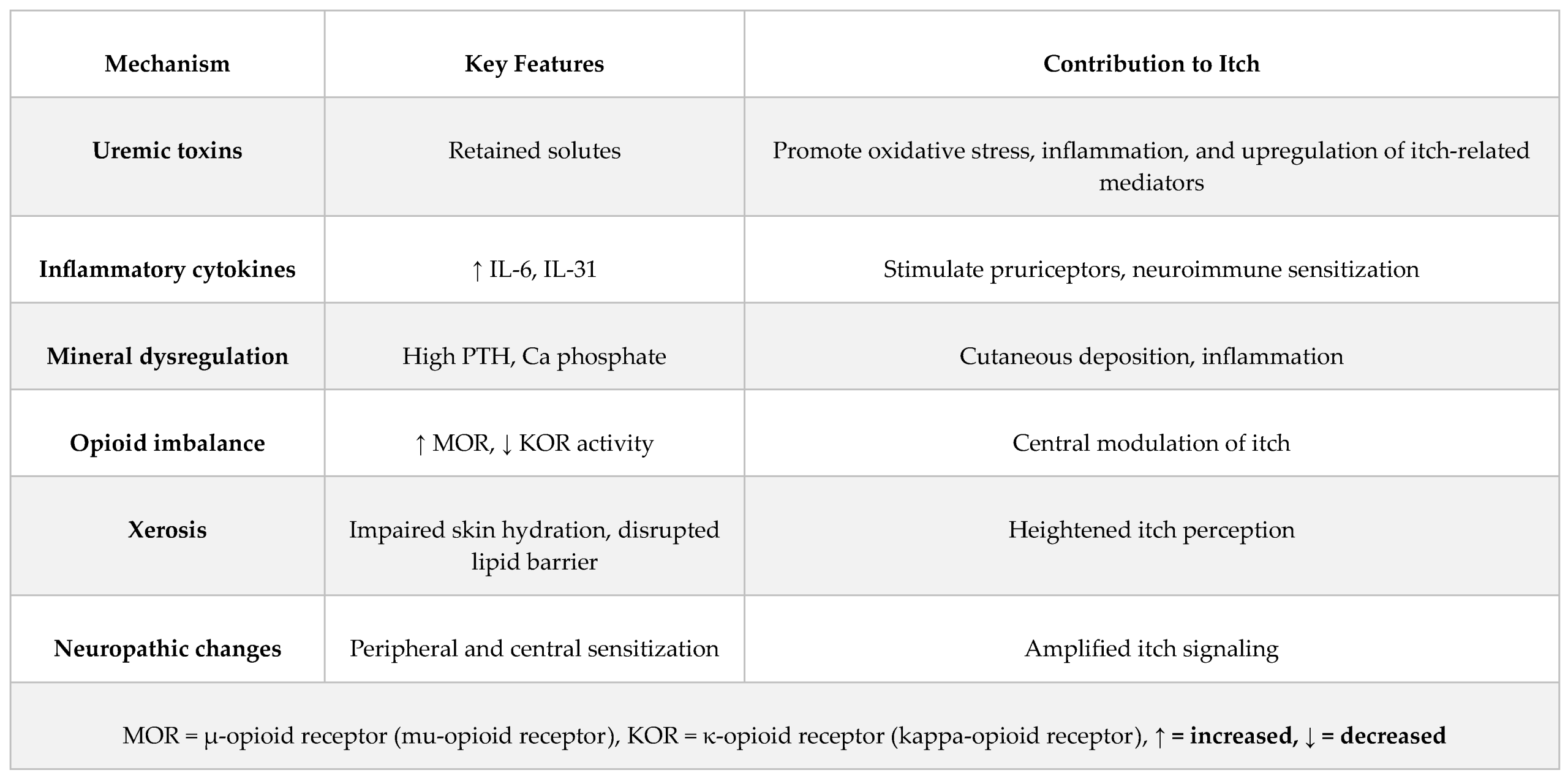
Uremic pruritus in hemodialysis patients is influenced by accumulated toxins such as beta-2 microglobulin, indoxyl sulfate, and p-cresyl sulfate, which promote inflammation, oxidative stress, and itch-related nerve signaling. IL-31–driven immune activation further amplifies itching, while older studies suggested links with high phosphate and mineral imbalance, though recent evidence is inconsistent. Rarely, severe uremia can cause urea crystallization (“uremic frost”) leading to intense itch.
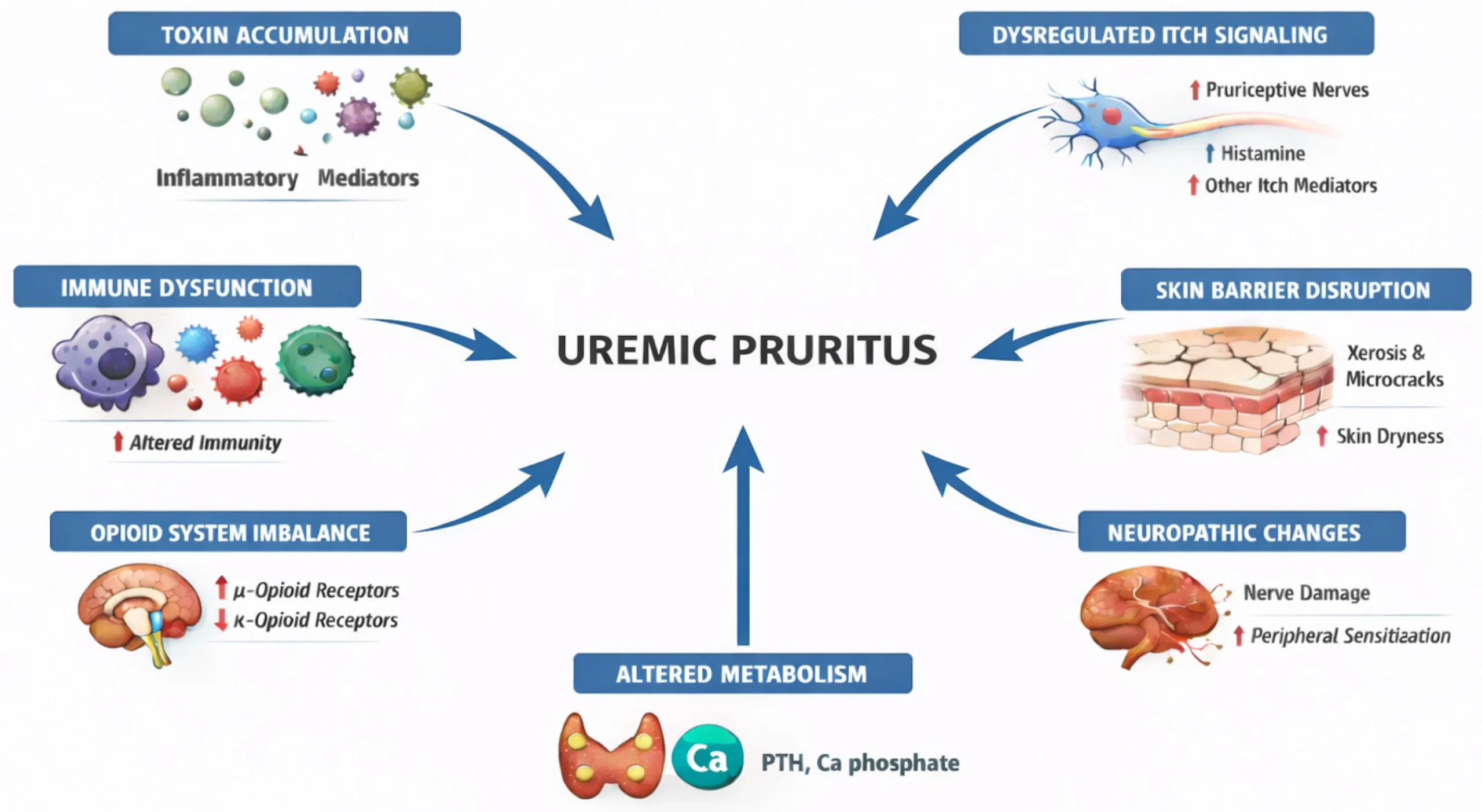
Other mechanisms include opioid imbalance—where increased μ-receptor and reduced κ-receptor activity promote itching—and xerosis due to impaired skin barrier function in CKD. Neuropathic factors also contribute, as uremic toxins and oxidative stress damage peripheral nerves, increasing their excitability. The beneficial response to gabapentinoids in many patients supports the role of neuropathic and central sensitization pathways in uremic pruritus.
Itching is common in CKD but not always uremic, so other causes must be excluded, including dermatologic diseases, liver or endocrine disorders, neuropathic or psychogenic causes, and drug-induced itch. Medications like diuretics, beta-blockers, ACE inhibitors, clonidine, and allopurinol can worsen symptoms, and infections such as scabies must be ruled out. Evaluation includes history, exam, and basic labs, with xerosis, excoriations, or lichenification often seen. Dermatologic review helps differentiate uremic itch from dermatitis, psoriasis, scabies, or drug reactions.
Uremic pruritus may be localized or generalized, often symmetric, and commonly worsens at night or around dialysis sessions, affecting sleep and quality of life. Comorbidities such as diabetes, cardiovascular disease, neurologic disorders, and depression can worsen symptoms. Pruritus is underrecognized because clinicians seldom ask and patients underreport. Standardized tools support assessment: VAS and WI-NRS for intensity, and 5-D Itch Scale, Skindex-10, and ItchyQoL for broader impact.
Because xerosis is common in CKD patients, regular skin hydration is a first-line measure. The 2025 European pruritus guideline recommends general measures such as wearing soft cotton clothing, keeping room temperature cool, avoiding spicy foods and alcohol, using lukewarm baths with gentle cleansers, and moisturizing immediately after drying the skin. Nails should be kept short, and patients should avoid irritants like hot baths, saunas, and harsh soaps. Cooling wet wraps may provide temporary relief, and education on breaking the itch–scratch cycle is essential.
Moisturizers and emollients help restore the skin barrier and reduce transepidermal water loss. Products containing humectants (urea, glycerin, dexpanthenol, hyaluronic acid) and lipids can significantly improve dryness and pruritus. A recent randomized trial showed that an emollient with 15% glycerin and 10% paraffin improved xerosis and itch more effectively than vehicle alone. Irritant or fragrance-containing products should be avoided.
Topical capsaicin can reduce itch by depleting substance P, but its use is limited by burning sensations, poor tolerability, and difficulty in blinding studies. Although early studies showed improvement, later reviews found only modest benefit, so its use must be individualized.
Although pruritus has decreased over time, it still affects many hemodialysis patients and should be recognized early. Because it impacts quality of life, it can serve as a quality indicator in dialysis units.
Improving dialysis adequacy may help some patients, but evidence is mixed. Pruritus should prompt clinicians to review the dialysis prescription, especially when Kt/V is below 1.2. Increasing adequacy to around 1.4 is recommended regardless of itching, as poor dialysis is linked to worse outcomes.
Dialyzer type may also influence symptoms. High-flux membranes and those with better β2-microglobulin clearance (e.g., PMMA membranes) have shown improvement in several studies. Patients may benefit from switching dialyzers if hypersensitivity is suspected, using more biocompatible options such as cellulose triacetate or vitamin E–coated membranes.
Other strategies include using medium cut-off filters for better middle-molecule removal, increasing blood flow rates, or adding hemadsorption/hemoperfusion, which can improve β2-microglobulin clearance and reduce pruritus, particularly when combined with high-flux dialysis.
A variety of drugs have been studied for uremic pruritus in hemodialysis patients, reflecting its complex mechanisms. Common options include gabapentin and pregabalin, which reduce neuronal excitability but require caution due to renal clearance and risk of neurotoxicity. Antidepressants (doxepin, sertraline), antihistamines (dexchlorpheniramine, ketotifen), serotonin blockers (ondansetron), and opioid modulators (nalbuphine, difelikefalin) have also been evaluated.
Low-dose gabapentin (100 mg post-dialysis) consistently shows good efficacy with fewer side effects than higher doses. Pregabalin reduces itch more than gabapentin but causes more sedation and dizziness. Comparisons with doxepin and antihistamines show gabapentin/pregabalin generally perform better. Ondansetron is no more effective than placebo.
Sertraline improves itch in some studies, likely due to anti-inflammatory effects, but pregabalin remains more effective. Nalbuphine ER significantly reduces itch, especially in severe cases, but causes nausea and somnolence during dose titration. Difelikefalin shows promising results with manageable side effects.
Overall, gabapentin/pregabalin and opioid-targeting agents offer the most consistent benefits, but dosing must be individualized due to safety concerns.
Several systemic agents have been studied for uremic pruritus in hemodialysis patients.
AST-120, an oral adsorbent, reduced itch severity along with uremic toxins and inflammatory markers. Montelukast (10 mg/day) improved pruritus and decreased inflammation in a one-month trial.
Melatonin also showed short-term improvement, but small sample size limits conclusions.
Increasing blood pump speed and using activated charcoal helped reduce itching in a crossover study. Omega-3 fatty acids demonstrated mixed results—some trials showed meaningful itch reduction and lower PGE2, while others found no significant benefit versus placebo. Overall, these treatments show potential but evidence remains inconsistent and mostly short-term.
Dupilumab, which blocks IL-4/IL-13 signaling, has emerging evidence for reducing uremic pruritus.Small case series and retrospective studies (5–12 patients) reported significant itch reduction without major adverse effects. Some patients discontinued early due to rapid improvement or cost. Dupilumab appeared more consistently effective in CKD patients with atopic or type-2 inflammatory features.
However, data are limited, sample sizes are small, and controlled trials are lacking—so its role in isolated uremic pruritus remains uncertain. Larger prospective studies are needed before firm recommendations can be made.
Uremic pruritus remains a common and clinically significant complication in patients receiving maintenance hemodialysis, with a substantial negative impact on quality of life. Despite increasing insight into its multifactorial pathophysiology, effective management remains challenging, and many patients experience persistent symptoms despite conventional therapies. Recent advances, including targeted neuromodulatory and immunomodulatory treatments, offer promising new options but require further validation in well-designed clinical trials. A deeper understanding of underlying mechanisms and patient-specific factors is essential to improve individualized treatment strategies and clinical outcomes
1. Hu, X.; Sang, Y.; Yang, M.; Chen, X.; Tang, W. Prevalence of Chronic Kidney Disease-Associated Pruritus among Adult Dialysis Patients: A Meta-Analysis of Cross-Sectional Studies. *Medicine* **2018**, *97*, e10633.
2. Li, M.; Jiang, P.; Zhao, X.; Ning, Y.; Huang, L. Prevalence and Influencing Factors of Pruritus in Maintenance Hemodialysis Patients in China: A Meta-Analysis. *BMC Nephrol.* **2025**, *26*, 266.
3. Weiss, M.; Mettang, T.; Tschulena, U.; Passlick-Deetjen, J.; Weisshaar, E. Prevalence of Chronic Itch and Associated Factors in Haemodialysis Patients: A Representative Cross-Sectional Study. *Acta Derm.-Venereol.* **2015**, *95*, 816–821.
4. Radwan, H.; Sulaiman, I.; Abbas, A. A Study of the Prevalence of Pruritus in Hemodialysis Patients and Its Relationship with Laboratory Indicators and Dialysis Characteristics. *Int. J. Med. Sci.* **2023**, *10*, 38–45.
5. Aghakhani, N.; Afan Naqshbandi, V.; Naderi, R. Uremic Pruritus: A Serious Global Health Concern for Patients Undergoing Hemodialysis. *Physiol. Pharmacol.* **2025**, *29*, 1–2.
6. Rayner, H.C.; Larkina, M.; Wang, M.; Graham-Brown, M.; van der Veer, S.N.; Ecder, T.; Hasegawa, T.; Kleophas, W.; Bieber, B.A.; Tentori, F.; et al. International Comparisons of Prevalence, Awareness, and Treatment of Pruritus in People on Hemodialysis. *Clin. J. Am. Soc. Nephrol.* **2017**, *12*, 2000–2007.
7. Shirazian, S.; Aina, O.; Park, Y.; Chowdhury, N.; Leger, K.; Hou, L.; Miyawaki, N.; Mathur, V.S. Chronic Kidney Disease-Associated Pruritus: Impact on Quality of Life and Current Management Challenges. *Int. J. Nephrol. Renov. Dis.* **2017**, *10*, 11–26.
8. Satti, M.Z.; Arshad, D.; Javed, H.; Shahroz, A.; Tahir, Z.; Ahmed, M.M.H.; Kareem, A. Uremic Pruritus: Prevalence and Impact on Quality of Life and Depressive Symptoms in Hemodialysis Patients. *Cureus* **2019**, *11*, e5178.
9. Suseł, J.; Batycka-Baran, A.; Reich, A.; Szepietowski, J.C. Uraemic Pruritus Markedly Affects the Quality of Life and Depressive Symptoms in Haemodialysis Patients with End-Stage Renal Disease. *Acta Derm. Venereol.* **2014**, *94*, 276–281.
10. Esteve-Simó, V.; Perez-Morales, R.; Buades-Fuster, J.M.; Arenas Jimenez, M.D.; Areste-Fosalba, N.; Alcalde Bezhold, G.; Blanco Santos, A.; Sanchez Álvarez, E.; Sanchez Villanueva, R.; Molina, P.; et al. Chronic Kidney Disease–Associated Pruritus and Quality of Life: Learning from Our Patients. *J. Clin. Med.* **2023**, *12*, 4505.
11. Mettang, T.; Pauli-Magnus, C.; Alscher, D.M. Uraemic Pruritus—New Perspectives and Insights from Recent Trials. *Nephrol. Dial. Transpl.* **2002**, *17*, 1558–1563.
12. Weng, C.-H.; Hu, C.-C.; Yen, T.-H.; Hsu, C.-W.; Huang, W\.-H. Uremic Pruritus Is Associated with Two-Year Cardiovascular Mortality in Long Term Hemodialysis Patients. *Kidney Blood Press. Res.* **2018**, *43*, 1000–1009.
13. Ting, S.-W.; Fan, P.-C.; Lin, Y.-S.; Lin, M.-S.; Lee, C.-C.; Kuo, G.; Chang, C.-H. Uremic Pruritus and Long-Term Morbidities in the Dialysis Population. *PLoS ONE* **2020**, *15*, e0241088.
14. Andoh, T.; Maki, T.; Li, S.; Uta, D. Β2-Microglobulin Elicits Itch-Related Responses in Mice through the Direct Activation of Primary Afferent Neurons Expressing Transient Receptor Potential Vanilloid 1. *Eur. J. Pharmacol.* **2017**, *810*, 134–140.
15. Liabeuf, S.; Drüeke, T.B.; Massy, Z.A. Protein-Bound Uremic Toxins: New Insight from Clinical Studies. *Toxins* **2011**, *3*, 911–919.
16. Schepers, E.; Meert, N.; Glorieux, G.; Goeman, J.; Van der Eycken, J.; Vanholder, R. P-Cresylsulphate, the Main in Vivo Metabolite of p-Cresol, Activates Leucocyte Free Radical Production. *Nephrol. Dial. Transpl.* **2007**, *22*, 592–596.
17. Yu, M.; Kim, Y.J.; Kang, D.-H. Indoxyl Sulfate-Induced Endothelial Dysfunction in Patients with Chronic Kidney Disease via an Induction of Oxidative Stress. *Clin. J. Am. Soc. Nephrol.* **2011**, *6*, 30–39.
18. Kim, S.; Zhang, X.; Cho, S.; Kim, C.; Park, H.; Moon, S. Uremic Solutes of Indoxyl Sulfate and P-Cresol Enhance Protease-Activated Receptor-2 Expression In Vitro and In Vivo in Keratinocytes. *Hum. Exp. Toxicol.* **2021**, *40*, 113–123.
19. Wang, C.-P.; Lu, Y.-C.; Tsai, I.-T.; Tang, W\.-H.; Hsu, C.-C.; Hung, W\.-C.; Yu, T.-H.; Chen, S.-C.; Chung, F.-M.; Lee, Y.-J.; et al. Increased Levels of Total P-Cresylsulfate Are Associated with Pruritus in Patients with Chronic Kidney Disease. *Dermatology* **2016**, *232*, 363–370.
20. Akl, E.M.; El-Eraki, J.M.; Elfallah, A.A.; Mohamed, N.H.; Maher, A.M.; Mansour, A.E.; Abdelsalam, O.H. Does Indoxyl Sulfate Have a Role in Uremic Pruritus? A Laboratory and Interventional Study. *J. Cutan. Med. Surg.* **2024**, *28*, 44–50.
21. Yamamoto, S.; Tanaka, T.; Omori, K.; Ei, I.; Kikuchi, K.; Konagai, A.; Goto, S.; Kitamura, N.; Narita, I. Pruritus and Protein-Bound Uremic Toxins in Patients Undergoing Hemodialysis: A Cross-Sectional Study. *Clin. Kidney J.* **2024**, *17*, sfae007.
22. Zibandeh, N.; Li, Z.; Ogg, G.; Bottomley, M.J. Cutaneous Adaptive Immunity and Uraemia: A Narrative Review. *Front. Immunol.* **2024**, *15*, 1464338.
23. Wu, C.-C.; Tian, Y.-C.; Lu, C.-L.; Wu, M.-J.; Lim, P.-S.; Chiu, Y.-W.; Kuo, K.-L.; Liu, S.-H.; Chou, Y.-C.; Sun, C.-A.; et al. AST-120 Improved Uremic Pruritus by Lowering Indoxyl Sulfate and Inflammatory Cytokines in Hemodialysis Patients. *Aging* **2024**, *16*, 4236–4249.
24. Duque, M.I.; Thevarajah, S.; Chan, Y.H.; Tuttle, A.B.; Freedman, B.I.; Yosipovitch, G. Uremic Pruritus Is Associated with Higher Kt/V and Serum Calcium Concentration. *Clin. Nephrol.* **2006**, *66*, 184–191.
25. Saardi, K.M.; Schwartz, R.A. Uremic frost: A harbinger of impending renal failure. *Int. J. Dermatol.* **2016**, *55*, 17–20.
26. Elevated C-Reactive Protein Level in Hemodialysis Patients with Moderate/Severe Uremic Pruritus: A Potential Mediator of High Overall Mortality|QJM: An International Journal of Medicine|Oxford Academic. Available online: [**https://academic.oup.com/qjmed/article-abstract/103/11/837/1588074?redirectedFrom=fulltext**](https://academic.oup.com/qjmed/article-abstract/103/11/837/1588074?redirectedFrom=fulltext) (accessed on 5 October 2025).
27. Kimmel, M.; Alscher, D.M.; Dunst, R.; Braun, N.; Machleidt, C.; Kiefer, T.; Stülten, C.; van der Kuip, H.; Pauli-Magnus, C.; Raub, U.; et al. The Role of Micro-Inflammation in the Pathogenesis of Uraemic Pruritus in Haemodialysis Patients. *Nephrol. Dial. Transpl.* **2006**, *21*, 749–755.
28. Datsi, A.; Steinhoff, M.; Ahmad, F.; Alam, M.; Buddenkotte, J. Interleukin-31: The “Itchy” Cytokine in Inflammation and Therapy. *Allergy* **2021**, *76*, 2982–2997.
29. Świerczyńska, K.; Krajewski, P.K.; Nowicka-Suszko, D.; Białynicki-Birula, R.; Krajewska, M.; Szepietowski, J.C. The Serum Level of IL-31 in Patients with Chronic Kidney Disease-Associated Pruritus: What Can We Expect? *Toxins* **2022**, *14*, 197.
30. Oweis, A.O.; Al-Qarqaz, F.; Bodoor, K.; Heis, L.; Alfaqih, M.A.; Almomani, R.; Obeidat, M.A.; Alshelleh, S.A. Elevated Interleukin 31 Serum Levels in Hemodialysis Patients Are Associated with Uremic Pruritus. *Cytokine* **2021**, *138*, 155369.
31. Ko, M.-J.; Peng, Y.-S.; Wu, H.-Y. Uremic Pruritus: Pathophysiology, Clinical Presentation, and Treatments. *Kidney Res. Clin. Pr.* **2023**, *42*, 39–52.
32. Keithi-Reddy, S.R.; Patel, T.V.; Armstrong, A.W.; Singh, A.K. Uremic Pruritus. *Kidney Int.* **2007**, *72*, 373–377.
33. Gatmiri, S.M.; Mahdavi-Mazdeh, M.; Lessan-Pezeshki, M.; Abbasi, M. Uremic Pruritus and Serum Phosphorus Level. *Acta Med. Iran.* **2013**, *51*, 477–481.
34. Narita, I.; Alchi, B.; Omori, K.; Sato, F.; Ajiro, J.; Saga, D.; Kondo, D.; Skatsume, M.; Maruyama, S.; Kazama, J.J.; et al. Etiology and Prognostic Significance of Severe Uremic Pruritus in Chronic Hemodialysis Patients. *Kidney Int.* **2006**, *69*, 1626–1632.
35. Keshari, S.; Sipayung, A.D.; Hsieh, C.-C.; Su, L.-J.; Chiang, Y.-R.; Chang, H.-C.; Yang, W\.-C.; Chuang, T.-H.; Chen, C.-L.; Huang, C.-M. IL-6/p-BTK/p-ERK Signaling Mediates Calcium Phosphate-Induced Pruritus. *FASEB J.* **2019**, *33*, 12036–12046.
36. Ståhle-Bäckdahl, M.; Hägermark, O.; Lins, L.E.; Törring, O.; Hilliges, M.; Johansson, O. Experimental and Immunohistochemical Studies on the Possible Role of Parathyroid Hormone in Uraemic Pruritus. *J. Intern. Med.* **1989**, *225*, 411–415.
37. Sukul, N.; Karaboyas, A.; Csomor, P.A.; Schaufler, T.; Wen, W.; Menzaghi, F.; Rayner, H.C.; Hasegawa, T.; Al Salmi, I.; Al-Ghamdi, S.M.G.; et al. Self-Reported Pruritus and Clinical, Dialysis-Related, and Patient-Reported Outcomes in Hemodialysis Patients. *Kidney Med.* **2021**, *3*, 42–53.e1.
38. Wulczyn, K.E.; Steele, D.J.R. One-Year Pruritus Trends Among Patients Receiving Hemodialysis and Associated Outcomes. *Am. J. Kidney Dis.* **2023**, *82*, 647–649.
39. Bigliardi, P.L.; Bigliardi-Qi, M. Peripheral Opioids. In *Itch: Mechanisms and Treatment*; Carstens, E., Akiyama, T., Eds.; Frontiers in Neuroscience; CRC Press/Taylor & Francis: Boca Raton, FL, USA, 2014; ISBN 978-1-4665-0543-8.
40. Bigliardi, P.L.; Bigliardi-Qi, M.; Buechner, S.; Rufli, T. Expression of μ-Opiate Receptor in Human Epidermis and Keratinocytes. *J. Investig. Dermatol.* **1998**, *111*, 297–301.
41. Bigliardi, P.L.; Tobin, D.J.; Gaveriaux-Ruff, C.; Bigliardi-Qi, M. Opioids and the Skin–Where Do We Stand? *Exp. Dermatol.* **2009**, *18*, 424–430.
42. Umeuchi, H.; Togashi, Y.; Honda, T.; Nakao, K.; Okano, K.; Tanaka, T.; Nagase, H. Involvement of Central μ-Opioid System in the Scratching Behavior in Mice, and the Suppression of It by the Activation of κ-Opioid System. *Eur. J. Pharmacol.* **2003**, *477*, 29–35.
43. Kim, B.S.; Inan, S.; Ständer, S.; Sciascia, T.; Szepietowski, J.C.; Yosipovitch, G. Role of Kappa–opioid and Mu–opioid Receptors in Pruritus: Peripheral and Central Itch Circuits. *Exp. Dermatol.* **2022**, *31*, 1900–1907.
44. Wang, Z.; Jiang, C.; Yao, H.; Chen, O.; Rahman, S.; Gu, Y.; Zhao, J.; Huh, Y.; Ji, R.-R. Central Opioid Receptors Mediate Morphine-Induced Itch and Chronic Itch via Disinhibition. *Brain* **2021**, *144*, 665–681.
45. Sakakihara, M.; Imamachi, N.; Saito, Y. Effects of Intrathecal κ-Opioid Receptor Agonist on Morphine-Induced Itch and Antinociception in Mice. *Reg. Anesth. Pain. Med.* **2016**, *41*, 69–74.
46. Kardon, A.P.; Polgár, E.; Hachisuka, J.; Snyder, L.M.; Cameron, D.; Savage, S.; Cai, X.; Karnup, S.; Fan, C.R.; Hemenway, G.M.; et al. Dynorphin Acts as a Neuromodulator to Inhibit Itch in the Dorsal Horn of the Spinal Cord. *Neuron* **2014**, *82*, 573–586.
47. Wieczorek, A.; Krajewski, P.; Kozioł-Gałczyńska, M.; Szepietowski, J.C. Opioid Receptors Expression in the Skin of Haemodialysis Patients Suffering from Uraemic Pruritus. *J. Eur. Acad. Dermatol. Venereol.* **2020**, *34*, 2368–2372.
48. Mathur, V.S.; Kumar, J.; Crawford, P.W.; Hait, H.; Sciascia, T. TR02 Study Investigators A Multicenter, Randomized, Double-Blind, Placebo-Controlled Trial of Nalbuphine ER Tablets for Uremic Pruritus. *Am. J. Nephrol.* **2017**, *46*, 450–458.
49. Fluhr, J.W.; Muguet, V.; Christen-Zaech, S. Restoring Skin Hydration and Barrier Function: Mechanistic Insights Into Basic Emollients for Xerosis Cutis. *Int. J. Dermatol.* **2025**, *64*, 5–12.
50. Szepietowski, J.C.; Reich, A.; Schwartz, R.A. Uraemic Xerosis. *Nephrol. Dial. Transpl.* **2004**, *19*, 2709–2712.
51. Lipid Content and Barrier Function Analysis in Uraemic Pruritus. Available online: [**http://www.medicaljournals.se/acta/content/html/10.2340/00015555-2266?utm_source=chatgpt.com**](http://www.medicaljournals.se/acta/content/html/10.2340/00015555-2266?utm_source=chatgpt.com) (accessed on 18 October 2025).
52. Biazus Soares, G.; Hashimoto, T.; Yosipovitch, G. Atopic Dermatitis Itch: Scratching for an Explanation. *J. Investig. Dermatol.* **2024**, *144*, 978–988.
53. Camargo, C.R.S.D.; Schoueri, J.H.M.; Alves, B.D.C.A.; Veiga, G.R.D.; Fonseca, F.L.; Bacci, M.R. Uremic Neuropathy: An Overview of the Current Literature. *Rev. Assoc. Med. Bras. (1992)* **2019**, *65*, 469–474. [[**Google Scholar**](https://scholar.google.com/scholar_lookup?title=Uremic+Neuropathy:+An+Overview+of+the+Current+Literature\&author=Camargo,+C.R.S.D.\&author=Schoueri,+J.H.M.\&author=Alves,+B.D.C.A.\&author=Veiga,+G.R.D.\&author=Fonseca,+F.L.\&author=Bacci,+M.R.\&publication_year=2019\&journal=Rev.+Assoc.+Med.+Bras.+\(1992\)\&volume=65\&pages=469%E2%80%93474\&doi=10.1590/1806-9282.65.3.469)]
54. Bolton, C.F. Peripheral Neuropathies Associated with Chronic Renal Failure. *Can. J. Neurol. Sci.* **1980**, *7*, 89–96.
55. Mahmoud, O.; Oladipo, O.; Mahmoud, R.H.; Yosipovitch, G. Itch: From the Skin to the Brain—Peripheral and Central Neural Sensitization in Chronic Itch. *Front. Mol. Neurosci.* **2023**, *16*, 1272230.
56. Akhyani, M.; Ganji, M.-R.; Samadi, N.; Khamesan, B.; Daneshpazhooh, M. Pruritus in Hemodialysis Patients. *BMC Dermatol.* **2005**, *5*, 7.
57. Khan, N.J.; Haider, S.; Gilani, A.; Iqbal, N.; Ali, S.A.; Abbasi, M.A. Comparing the Efficacy and Safety of Pregabalin vs. Gabapentin in Uremic Pruritus in Patients of Chronic Kidney Injury Undergoing Haemodialysis. *J. Ayub Med. Coll. Abbottabad* **2022**, *34*, 524–527.
58. Roh, Y.S.; Choi, J.; Sutaria, N.; Kwatra, S.G. Itch: Epidemiology, Clinical Presentation, and Diagnostic Workup. *J. Am. Acad. Dermatol.* **2022**, *86*, 1–14.
59. Osakwe, N.; Rout, P. Uremic Pruritus Evaluation and Treatment. In *StatPearls*; StatPearls Publishing: Treasure Island, FL, USA, 2025.
60. Manenti, L.; Leuci, E. Do You Feel Itchy? A Guide towards Diagnosis and Measurement of Chronic Kidney Disease-Associated Pruritus in Dialysis Patients. *Clin. Kidney J.* **2021**, *14*, i8–i15.
61. Lempert, K.D.; Baltz, P.S.; Welton, W\.A.; Whittier, F.C. Pseudouremic Pruritus: A Scabies Epidemic in a Dialysis Unit. *Am. J. Kidney Dis.* **1985**, *5*, 117–119. [[**Google Scholar**](https://scholar.google.com/scholar_lookup?title=Pseudouremic+Pruritus:+A+Scabies+Epidemic+in+a+Dialysis+Unit\&author=Lempert,+K.D.\&author=Baltz,+P.S.\&author=Welton,+W.A.\&author=Whittier,+F.C.\&publication_year=1985\&journal=Am.+J.+Kidney+Dis.\&volume=5\&pages=117%E2%80%93119\&doi=10.1016/S0272-6386\(85\)80006-8\&pmid=2578731)] [[**CrossRef**](https://doi.org/10.1016/S0272-6386\(85\)80006-8)]
62. Deabate, M.C.; Calitri, V.; Licata, C.; Fidelio, T.; Rocchietti, M.; Pieri, F.; Gagliano, P.; Rabbia, C.; Dogliani, M. Scabies in a dalysis unit. Mystery and prejudice. *Minerva Urol. Nefrol.* **2001**, *53*, 69–73.
63. Khan, A.; O’Grady, S.; Muller, M.P. Rapid Control of a Scabies Outbreak at a Tertiary Care Hospital without Ward Closure. *Am. J. Infect. Control* **2012**, *40*, 451–455.
64. Tollitt, J.; Duncan, A.; Woywodt, A. Of Mites and Men: Scabies in Patients with Kidney Disease. *Clin. Kidney J.* **2013**, *6*, 125–127.
65. Cheng, A.-Y.; Wong, L.-S.; Cheng, A.-Y.; Wong, L.-S. Uremic Pruritus: From Diagnosis to Treatment. *Diagnostics* **2022**, *12*, 1108.
66. Świerczyńska, K.; Białynicki-Birula, R.; Szepietowski, J.C. Chronic Intractable Pruritus in Chronic Kidney Disease Patients: Prevalence, Impact, and Management Challenges—A Narrative Review. *Ther. Clin. Risk Manag.* **2021**, *17*, 1267–1282.
67. Rehman, I.U.; Chan, K.G.; Munib, S.; Lee, L.H.; Khan, T.M. The Association between CKD-Associated Pruritus and Quality of Life in Patients Undergoing Hemodialysis in Pakistan. *Medicine* **2019**, *98*, e16812.
68. Kim, D.; Pollock, C. Epidemiology and Burden of Chronic Kidney Disease-Associated Pruritus. *Clin. Kidney J.* **2021**, *14*, i1–i7.
69. Aresi, G.; Rayner, H.C.; Hassan, L.; Burton, J.O.; Mitra, S.; Sanders, C.; van der Veer, S.N. Reasons for Underreporting of Uremic Pruritus in People with Chronic Kidney Disease: A Qualitative Study. *J. Pain. Symptom Manag.* **2019**, *58*, 578–586.e2.
70. Rigatto, C.; Collister, D.; Granger-Vallée, A.; Girard, L.; Hingwala, J.; Karaboyas, A.; Levin, A.; McFarlane, P.; Pisoni, R.; Prasad, B.; et al. Pathways for Diagnosing and Treating CKD-Associated Pruritus: A Narrative Review. *Can. J. Kidney Health Dis.* **2024**, *11*, 20543581241238808.
71. Jang, Y.H.; Kim, S.M.; Eun, D.H.; Park, K.D.; Park, G.H.; Kim, B.S.; Li, K.; Park, C.O.; Kim, H.O.; Kim, H.S.; et al. Validity and Reliability of Itch Assessment Scales for Chronic Pruritus in Adults: A Prospective Multicenter Study. *J. Am. Acad. Dermatol.* **2020**, *82*, 80–86.
72. Vernon, M.K.; Swett, L.L.; Speck, R.M.; Munera, C.; Spencer, R.H.; Wen, W.; Menzaghi, F. Psychometric Validation and Meaningful Change Thresholds of the Worst Itching Intensity Numerical Rating Scale for Assessing Itch in Patients with Chronic Kidney Disease-Associated Pruritus. *J. Patient Rep. Outcomes* **2021**, *5*, 134.
73. Guedes, M.; Tu, C.; Sukul, N.; Asgari, E.; Guebre-Egziabher, F.; Ruessmann, D.; Schaufler, T.; Rayner, H.; Jadoul, M.; Labriola, L.; et al. Chronic Kidney Disease-Associated Pruritus: A Comparison of Instruments and Associations with Patient-Reported Outcomes Using an Electronic Patient-Reported Outcome Survey in Europe. *Clin. Kidney J.* **2024**, *17*, sfae276.
74. Altınok Ersoy, N.; Akyar, İ. Multidimensional Pruritus Assessment in Hemodialysis Patients. *BMC Nephrol.* **2019**, *20*, 42.
75. Weisshaar, E.; Müller, S.; Szepietowski, J.C.; Dalgard, F.; Garcovich, S.; Kupfer, J.; Gimenez-Arnau, A.; Lambert, J.; Mettang, T.; Misery, L.; et al. European S2k Guideline on Chronic Pruritus. *Acta Derm. Venereol.* **2025**, *105*, adv44220.
76. Butler, D.C.; Berger, T.; Elmariah, S.; Kim, B.; Chisolm, S.; Kwatra, S.G.; Mollanazar, N.; Yosipovitch, G. Chronic Pruritus: A Review. *JAMA* **2024**, *331*, 2114–2124.
77. Lipman, Z.M.; Paramasivam, V.; Yosipovitch, G.; Germain, M.J. Clinical Management of Chronic Kidney Disease-Associated Pruritus: Current Treatment Options and Future Approaches. *Clin. Kidney J.* **2021**, *14*, i16–i22.
78. Chang, P.-C.; Liao, I.-C. Hydration, Barrier of Skin and Uremic Pruritus in Patients Undergoing Hemodialysis: A Pilot Investigation. *Nephrol. Ther.* **2022**, *18*, 498–505.
79. Szepietowski, J.C.; Kemeny, L.; Mettang, T.; Arenberger, P. Long-Term Efficacy and Tolerability of an Emollient Containing Glycerol and Paraffin for Moderate-to-Severe Uremic Xerosis: A Randomized Phase 3 Study. *Dermatol. Ther.* **2024**, *14*, 3033–3046.
80. Verma, V.; Lamture, Y.; Ankar, R.; Verma, V.; Lamture, Y.; Ankar, R. Management of Uremic Xerosis and Chronic Kidney Disease (CKD)-Associated Pruritus (CKD-Ap) with Topical Preparations: A Systematic Review and Implications in the Indian Context. *Cureus* **2023**, *15*, e42587. [[**Google Scholar**](https://scholar.google.com/scholar_lookup?title=Management+of+Uremic+Xerosis+and+Chronic+Kidney+Disease+\(CKD\)-Associated+Pruritus+\(CKD-Ap\)+with+Topical+Preparations:+A+Systematic+Review+and+Implications+in+the+Indian+Context\&author=Verma,+V.\&author=Lamture,+Y.\&author=Ankar,+R.\&author=Verma,+V.\&author=Lamture,+Y.\&author=Ankar,+R.\&publication_year=2023\&journal=Cureus\&volume=15\&pages=e42587\&doi=10.7759/cureus.42587\&pmid=37641756)]
81. Yeam, C.T.; Yo, T.E.; Tan, Y.L.C.; Liew, A.; Seng, J.J.B. Complementary and Alternative Medicine Therapies for Uremic Pruritus—A Systematic Review of Randomized Controlled Trials. *Complement. Ther. Med.* **2021**, *56*, 102609.
82. Singh, V.S.; Vinayadev, V. Effectiveness of Baby Oil Therapy for Uremic Pruritus in Hemodialysis Patients. *Saudi J. Kidney Dis. Transpl.* **2021**, *32*, 163–169.
83. Nevols, J.; Watkins, L.; Lewis, R. A Phase IV, Randomised, Double-Blind, Controlled, Parallel Group Trial to Evaluate the Effectiveness and Safety of Balneum Plus versus Emollient in the Treatment of Chronic Kidney Disease-Associated Pruritus in Haemodialysis Patients. *Clin. Kidney J.* **2023**, *16*, 1307–1315.
84. Yahya, Y.F.; Roiana, N.; Andarina, R.; Suprapti, S.; Saleh, I. Efficacy of 20% Urea Cream on Uremic Pruritus with Uremic Xerosis in Chronic Renal Failure Patients Undergoing Hemodialysis. *Berk. Ilmu Kesehat. Kulit Dan. Kelamin* **2018**, *30*, 1–9.
85. Muliani, R.; Vitniawati, V.; Rakhman, D.A. Effectiveness of Olive Oil with Virgin Coconut Oil on Pruritus Grade Scores Among Hemodialysis Patients. *Int. J. Adv. Life Sci. Res.* **2021**, *4*, 25–33.
86. Aquino, T.M.O.; Luchangco, K.A.C.; Sanchez, E.V.; Verallo-Rowell, V.M. A Randomized Controlled Study of 6% Gabapentin Topical Formulation for Chronic Kidney Disease-Associated Pruritus. *Int. J. Dermatol.* **2020**, *59*, 955–961.
87. Anumas, S.; Kuropakornpong, P.; Chakkavittumrong, P.; Tasanarong, A.; Pattharanitima, P. Cannabis-Containing Cream for CKD-Associated Pruritus: A Double-Blind, Placebo Controlled Trial. *Kidney Med.* **2024**, *6*, 100894.
88. Widyastuti; Yahya, Y.F.; Nugroho, S.A.; Kartowigno, S.; Purwoko, M.I.H.; Saleh, I. Efficacy of Calcipotriol 0.005% Ointment for Uremic Xerosis with Pruritus in Chronic Kidney Diseases Undergoing Hemodialysis Patients: Randomized Double Blind Clinical Trial. *Biosci. Med. J. Biomed. Transl. Res.* **2021**, *5*, 531–539.
89. Khorsand, A.; Salari, R.; Noras, M.R.; Saki, A.; Jamali, J.; Sharifipour, F.; Mirmoosavi, S.J.; Ghazanfari, S.M. The Effect of Massage and Topical Violet Oil on the Severity of Pruritus and Dry Skin in Hemodialysis Patients: A Randomized Controlled Trial. *Complement. Ther. Med.* **2019**, *45*, 248–253.
90. Elsaie, L.T.; El Mohsen, A.M.; Ibrahim, I.M.; Mohey-Eddin, M.H.; Elsaie, M.L. Effectiveness of Topical Peppermint Oil on Symptomatic Treatment of Chronic Pruritus. *Clin. Cosmet. Investig. Dermatol.* **2016**, *9*, 333–338.
91. Mathur, V.S.; Lindberg, J.; Germain, M.; Block, G.; Tumlin, J.; Smith, M.; Grewal, M.; McGuire, D. ITCH National Registry Investigators. A Longitudinal Study of Uremic Pruritus in Hemodialysis Patients. *Clin. J. Am. Soc. Nephrol.* **2010**, *5*, 1410–1419.
92. van der Veer, S.N.; van Biesen, W.; Couchoud, C.; Tomson, C.R.V.; Jager, K.J. Measuring the Quality of Renal Care: Things to Keep in Mind When Selecting and Using Quality Indicators. *Nephrol. Dial. Transpl.* **2014**, *29*, 1460–1467.
93. Wulczyn, K.E.; Zhao, S.H.; Rhee, E.P.; Kalim, S.; Shafi, T. Trajectories of Uremic Symptom Severity and Kidney Function in Patients with Chronic Kidney Disease. *Clin. J. Am. Soc. Nephrol.* **2022**, *17*, 496–506.
94. Amro, A.; Waldum-Grevbo, B.; von der Lippe, N.; Brekke, F.B.; Miaskowski, C.; Os, I. Symptom Clusters from Dialysis to Renal Transplantation: A Five-Year Longitudinal Study. *J. Pain. Symptom Manag.* **2016**, *51*, 512–519.
95. Hiroshige, K.; Kabashima, N.; Takasugi, M.; Kuroiwa, A. Optimal Dialysis Improves Uremic Pruritus. *Am. J. Kidney Dis.* **1995**, *25*, 413–419. [[**Google Scholar**](https://scholar.google.com/scholar_lookup?title=Optimal+Dialysis+Improves+Uremic+Pruritus\&author=Hiroshige,+K.\&author=Kabashima,+N.\&author=Takasugi,+M.\&author=Kuroiwa,+A.\&publication_year=1995\&journal=Am.+J.+Kidney+Dis.\&volume=25\&pages=413%E2%80%93419\&doi=10.1016/0272-6386\(95\)90102-7)] [[**CrossRef**](https://doi.org/10.1016/0272-6386\(95\)90102-7)]
96. National Kidney Foundation KDOQI Clinical Practice Guideline for Hemodialysis Adequacy: 2015 Update. *Am. J. Kidney Dis.* **2015**, *66*, 884–930.
97. Pisoni, R.L.; Wikström, B.; Elder, S.J.; Akizawa, T.; Asano, Y.; Keen, M.L.; Saran, R.; Mendelssohn, D.C.; Young, E.W.; Port, F.K. Pruritus in haemodialysis patients: International results from the Dialysis Outcomes and Practice Patterns Study (DOPPS). *Nephrol. Dial. Transplant.* **2006**, *21*, 3495–3505. [[**Google Scholar**](https://scholar.google.com/scholar_lookup?title=Pruritus+in+haemodialysis+patients:+International+results+from+the+Dialysis+Outcomes+and+Practice+Patterns+Study+\(DOPPS\)\&author=Pisoni,+R.L.\&author=Wikstr%C3%B6m,+B.\&author=Elder,+S.J.\&author=Akizawa,+T.\&author=Asano,+Y.\&author=Keen,+M.L.\&author=Saran,+R.\&author=Mendelssohn,+D.C.\&author=Young,+E.W.\&author=Port,+F.K.\&publication_year=2006\&journal=Nephrol.+Dial.+Transplant.\&volume=21\&pages=3495%E2%80%933505\&doi=10.1093/ndt/gfl461)]
98. Ko, M.J.; Wu, H.Y.; Chen, H.Y.; Chiu, Y.L.; Hsu, S.P.; Pai, M.F.; Yang, J.Y.; Lai, C.F.; Lu, H.M.; Huang, S.C.; et al. Uremic pruritus, dialysis adequacy, and metabolic profiles in hemodialysis patients: A prospective 5-year cohort study. *PLoS ONE* **2013**, *8*, e71404.
99. Chen, Z.J.; Cao, G.; Tang, W\.X.; Lv, X.Y.; Huang, S.M.; Qin, W.; Ping, F.; Ye, T. A Randomized Controlled Trial of High-Permeability Haemodialysis against Conventional Haemodialysis in the Treatment of Uraemic Pruritus. *Clin. Exp. Dermatol.* **2009**, *34*, 679–683.
100. Aucella, F.; Vigilante, M.; Gesuete, A.; Maruccio, G.; Specchio, A.; Gesualdo, L. Uraemic Itching: Do Polymethylmethacrylate Dialysis Membranes Play a Role? *Nephrol. Dial. Transpl.* **2007**, *22*, v8–v12.
101. Kato, A.; Takita, T.; Furuhashi, M.; Takahashi, T.; Watanabe, T.; Maruyama, Y.; Hishida, A. Polymethylmethacrylate Efficacy in Reduction of Renal Itching in Hemodialysis Patients: Crossover Study and Role of Tumor Necrosis Factor-α. *Artif. Organs* **2001**, *25*, 441–447.
102. Torii, Y.; Yamada, S.; Yajima, M.; Sugata, T. Polymethylmethacrylate Membrane Dialyzer: Historic but Modern. *Blood Purif.* **2022**, *52*, 8–14.
103. Takahashi, N.; Mano, J.; Uchida, K.; Yoshizawa, T.; Kumagai, J.; Kawanishi, H.; Tsuchiya, S.; Moriishi, M.; Masaki, T. Efficacy of Polymethylmethacrylate Membrane Hemodiafilter Filtryzer® PMFTM-21A in Improving Pruritus in Hemodialysis Patients: A Prospective Interventional Study. *Ren. Replace. Ther.* **2023**, *9*, 39.
104. Zappulo, F.; Di Nunzio, M.; Donati, G.; Scrivo, A.; Chiocchini, A.L.C.; La Manna, G. Vitamin E-Coated Membrane Reversed Itchy Rash during Hemodialysis. *J. Nephrol.* **2024**, *37*, 2025–2028.
105. Esteras, R.; Martín-Navarro, J.; Ledesma, G.; Fernández-Prado, R.; Carreño, G.; Cintra, M.; Cidraque, I.; Sanz, I.; Tarragón, B.; Alexandru, S.; et al. Incidence of Hypersensitivity Reactions During Hemodialysis. *Kidney Blood Press. Res.* **2018**, *43*, 1472–1478.
106. Boer, W\.H.; Liem, Y.; de Beus, E.; Abrahams, A.C. Acute Reactions to Polysulfone/Polyethersulfone Dialysers: Literature Review and Management. *Neth. J. Med.* **2017**, *75*, 4–13.
107. Lim, J.-H.; Park, Y.; Yook, J.-M.; Choi, S.-Y.; Jung, H.-Y.; Choi, J.-Y.; Park, S.-H.; Kim, C.-D.; Kim, Y.-L.; Cho, J.-H. Randomized Controlled Trial of Medium Cut-off versus High-Flux Dialyzers on Quality of Life Outcomes in Maintenance Hemodialysis Patients. *Sci. Rep.* **2020**, *10*, 7780.
108. Zanganeh, M.; Abbasi, A.; Khosravi, A.; Amerian, M.; Ebrahimi, H. Effects of Increased Blood Flow Rate and Oral Activated Charcoal on the Severity of Uremic Pruritus: A Randomized Crossover Clinical Trial. *Saudi J. Kidney Dis. Transpl.* **2023**, *34*, 125–133.
109. Zhao, D.; Wang, Y.; Wang, Y.; Jiang, A.; Cao, N.; He, Y.; Wang, J.; Guo, Z.; Liu, W.; Shi, W.; et al. Randomized Control Study on Hemoperfusion Combined with Hemodialysis versus Standard Hemodialysis: Effects on Middle-Molecular-Weight Toxins and Uremic Pruritus. *Blood Purif.* **2022**, *51*, 812–822.
110. Calandre, E.P.; Rico-Villademoros, F.; Slim, M. Alpha2delta Ligands, Gabapentin, Pregabalin and Mirogabalin: A Review of Their Clinical Pharmacology and Therapeutic Use. *Expert. Rev. Neurother.* **2016**, *16*, 1263–1277.
111. Wesche, D.; Bockbrader, H. A Pharmacokinetic Comparison of Pregabalin and Gabapentin. *J. Pain.* **2005**, *6*, S29.
112. Ostadhadi, S.; Kordjazy, N.; Haj-Mirzaian, A.; Mansouri, P.; Dehpour, A.R. 5-HT3 Receptors Antagonists Reduce Serotonin-Induced Scratching in Mice. *Fundam. Clin. Pharmacol.* **2015**, *29*, 310–315.
113. Haber, R.; Bachour, J.; Salloum, A.; Maacaron, T.; Khoury, F.; Habr, L.; Ammoury, A.; Joubran, N. Comparison of Gabapentin and Doxepin in the Management of Uremic Pruritus: A Randomized Crossover Clinical Trial. *Dermatol. Ther.* **2020**, *33*, e14522.
114. Gobo-Oliveira, M.; Pigari, V.G.; Ogata, M.S.; Miot, H.A.; Ponce, D.; Abbade, L.P. Gabapentin versus Dexchlorpheniramine as Treatment for Uremic Pruritus: A Randomised Controlled Trial. *Eur. J. Dermatol.* **2018**, *28*, 488–495.
115. Yue, J.; Jiao, S.; Xiao, Y.; Ren, W.; Zhao, T.; Meng, J. Comparison of Pregabalin with Ondansetron in Treatment of Uraemic Pruritus in Dialysis Patients: A Prospective, Randomized, Double-Blind Study. *Int. Urol. Nephrol.* **2015**, *47*, 161–167.
116. Rossi, G.M.; Corradini, M.; Blanco, V.; Mattei, S.; Fiaccadori, E.; Vaglio, A.; Manenti, L. Randomized Trial of Two After-Dialysis Gabapentin Regimens for Severe Uremic Pruritus in Hemodialysis Patients. *Intern. Emerg. Med.* **2019**, *14*, 1341–1346.
117. Foroutan, N.; Etminan, A.; Nikvarz, N.; Shojai Shahrokh Abadi, M. Comparison of Pregabalin with Doxepin in the Management of Uremic Pruritus: A Randomized Single Blind Clinical Trial. *Hemodial. Int.* **2017**, *21*, 63–71.
118. Elsayed, M.M.; Elgohary, I.E.; Abdelhamid, H.H.S.; Zaki, S.A. The Effectiveness of Sertraline in Alleviating Uremic Pruritus in Hemodialysis Patients: A Randomized Clinical Trial. *BMC Nephrol.* **2023**, *24*, 155.
119. Pakfetrat, M.; Malekmakan, L.; Hashemi, N.; Tadayon, T. Sertraline Can Reduce Uremic Pruritus in Hemodialysis Patient: A Double Blind Randomized Clinical Trial from Southern Iran. *Hemodial. Int.* **2018**, *22*, 103–109.
120. Shamspour, N.; Aflatoonian, M.; Khalili, M.; Seifi, M.; Mousavi, M.; Azmandian, J.; Mohammadi, S.; Khoundabi, B.; Parsimood, E.; Mohebbi, A. Comparison of Pregabalin and Ketotifen in Treatment of Uremic Pruritus in Hemodialysis Patients. *Dermatol. Ther.* **2022**, *35*, e15579.
121. Yosipovitch, G.; Awad, A.; Spencer, R.H.; Munera, C.; Menzaghi, F. A Phase 2 Study of Oral Difelikefalin in Subjects with Chronic Kidney Disease and Moderate-to-Severe Pruritus. *J. Am. Acad. Dermatol.* **2023**, *89*, 261–268.
122. Abbas, A.; Arshad, A.R.; Iqbal, M. Comparison Between Pregabalin and Sertraline for Treatment of Uraemic Pruritus in Patients on Maintenance Haemodialysis: A Single-Centric Study. *J. Coll. Physicians Surg. Pak.* **2024**, *34*, 1061–1065.
123. Nofal, E.; Farag, F.; Nofal, A.; Eldesouky, F.; Alkot, R.; Abdelkhalik, Z. Gabapentin: A Promising Therapy for Uremic Pruritus in Hemodialysis Patients: A Randomized-Controlled Trial and Review of Literature. *J. Dermatol. Treat.* **2016**, *27*, 515–519.
124. Mahmudpour, M.; Roozbeh, J.; Raiss Jalali, G.A.; Pakfetrat, M.; Ezzat Zadegan, S.; Sagheb, M.M. Therapeutic Effect of Montelukast for Treatment of Uremic Pruritus in Hemodialysis Patients. *Iran. J. Kidney Dis.* **2017**, *11*, 50–55.
125. Baharvand, P.; Abbasi, M.R.; Ziaee Ardestani, S.; Esmaeili, A.; Namazi, S. Evaluation of Antipruritic Effect of Melatonin on Hemodialysis Patients with Uremic Pruritus, A Double-Blind, Randomized, Crossover Trial. *Iran. J. Kidney Dis.* **2021**, *15*, 38–47.
126. Teama, N.M.; Shawky, S.M.; Ibrahim, M.A.-H.; Khalifa, S.M.; El-Mobdy, A.H. Omega-3 Fatty Acids versus Gabapentin in Uremic Pruritus in Hemodialysis Patients: Randomized Controlled, Crossover Clinical Trial. *Egypt. J. Intern. Med.* **2025**, *37*, 69.
127. Forouhari, A.; Moghtaderi, M.; Raeisi, S.; Shahidi, S.; Parin Hedayati, Z.; Zaboliyan, J.; Ani, S.; Moeinzadeh, F.; Mortazavi, M. Pruritus-Reducing Effects of Omega-3 Fatty Acids in Hemodialysis Patients: A Cross-over Randomized Clinical Trial. *Hemodial. Int.* **2022**, *26*, 408–414.
128. Shayanpour, S.; Mousavi, S.S.B.; Rizi, P.L.; Cheraghian, B. The Effect of the Omega-3 Supplement on Uremic Pruritus in Hemodialysis Patients; a Double-Blind Randomized Controlled Clinical Trial. *J. Nephropathol.* **2017**, *8*, e13.
129. Rafieipoor, A.; Torkaman, M.; Azaryan, F.; Tavakoli, A.; Mohammadian, M.K.; Kohansal, A.; Shafaei, H.; Mirzaee, P.; Motiee Bijarpasi, Z.; Bahmani, P.; et al. Effectiveness of Omega-3 Fatty Acid Supplementation for Pruritus in Patients Undergoing Hemodialysis. *Front. Nutr.* **2024**, *11*, 1328469.
130. Zhai, L.L.; Savage, K.T.; Qiu, C.C.; Jin, A.; Valdes-Rodriguez, R.; Mollanazar, N.K. Chronic Pruritus Responding to Dupilumab-A Case Series. *Medicine* **2019**, *6*, 72.
131. Wang, Z.; Chen, C.; Xiong, Y.; Feng, Y.; Chen, J.; Xu, H. Efficacy of Dupilumab for Chronic Kidney Disease-Associated Pruritus in Patients Undergoing Hemodialysis: Retrospective Observational Study. *J. Am. Acad. Dermatol.* **2025**, *93*, 501–503.
132. Wang, Q.; Yang, G.; Zhou, X.; Zhong, X.; Liu, J.; Zhang, L. Dupilumab Relieves Pruritus Both in Uremic Pruritus and in Atopic Dermatitis with Chronic Kidney Disease: A Retrospective Real-World Study. *Front. Med.* **2025**, *12*, 1627955.